Up to this point we’ve looked at a variety of methods for understanding how motion can occur in the circular restricted three body problem. At one extreme, the existence of the Jacobi constant and its significance, in combination with the pseudopotential, allowed us to make quasi-global statements about the spatial extents of allowed motion without saying anything, per se, about the trajectories themselves. At the other extreme, the determination of the equilibrium points gives us some idea about very local structures and the trivial trajectories of the restricted bodies placed there. But in both cases, we haven’t said anything about specific, non-trivial trajectories that can be realized with the CR3BP. In this post and several ones hereafter we will address some of this topic.
Unlike the Kepler problem, where we know from analysis that the allowed solutions must be one of the four conic sections, the CR3BP admits quite rich behaviors and it is impossible to catalog all the possibilities. That said, one of the time-honored approaches is to look for periodic structures, sometimes called orbits or trajectories, interchangeably, within the CR3BP. As Roy describes it:
According to Poincaré’s conjecture, such orbits are dense in the set of all possible solutions of the problem that are bounded in phase space. It was hoped that their discovery and study would be sufficient for a qualitative description of all possible solutions, while their periodicity made their determination and the study of their properties easier.
One note of clarification is in order. By ‘Poincaré’s conjecture’, Roy does not mean the problem from topology that is famous now (see Poincaré conjecture – Wikipedia) but rather the recurrence theorem of Poincaré from which he conjectures that phase space is, in some way, dense in periodic orbits.
We are assisted significantly in the hunt for periodic orbits by a dynamical symmetry exhibited by the equations of motion. It is that symmetry that will concern us for the rest of this post.
To begin, let’s remind ourselves of the structure of the equations of motion which is:
\[ {\ddot x} – 2 {\dot y} = U_{,x} \; , \]
\[ {\ddot y} + 2 {\dot x} = U_{,y} \; , \]
and
\[ {\ddot z} = U_{,z} \; . \]
The pseudopotential $U(x,y,z)$ is defined as
\[ U = \frac{1}{2} \left( x^2 + y^2 \right) \, – \frac{1-\mu}{d_1} \, – \frac{\mu}{d_2} \; , \]
where
\[ d_1 = \sqrt{ (x+\mu)^2 + y^2 + z^2 } \; \]
and
\[ d_2 = \sqrt{ (x -1 +\mu)^2 + y^2 + z^2 } \; . \]
By their very nature, periodic orbits look the same whether time is running forward or running backward. Note that there is a philosophical point in the previous sentence that we will return to later. So, we want to snoop out a symmetry operation that we can perform that leaves the equations of motion unchanged when $t \rightarrow -t$.
Under time-reversal, the position components remain the same, as one might expect or even insist upon since time concerns motion not relative positioning. As a consequence, the pseudopotential, which only depends on the relative positions of the massive and the restricted body also remains unchanged. The velocities are all reversed in sign, since $dt \rightarrow -dt$ while, by the same argument, the accelerations remain unchanged as $dt^2 \rightarrow (-dt)^2 = dt^2$. The equations of motion are now subtly different only in the second terms on the left-hand side:
\[ {\ddot x} + 2{\dot y} = U_{,x} \; , \]
\[ {\ddot y} – 2{\dot x} = U_{,y} \; , \]
and
\[ {\ddot z} = U_{,z} \; . \]
How does one fix the equations of motion to restore their form? One might try making the spatial transformation of $x \rightarrow -x$ since:
\[ U_{,x} \rightarrow U_{,-x} = -U_{,x} \; , \]
\[ {\dot x} \rightarrow -{\dot x} \; , \]
and
\[ {\ddot x} \rightarrow -{\ddot x} \; .\]
This transformation would result in the first equation having an overall minus sign, which cancels out, and the second equation having the Coriolis term flipping its sign back to the original signature. However, both $d_1$ and $d_2$, would be different since:
\[ d_1 = \sqrt{ (x+\mu)^2 + y^2 + z^2 } \rightarrow \sqrt{ (-x+\mu)^2 + y^2 +z^2 } \; \]
and
\[ d_2 = \sqrt{ (x-1+\mu)^2 + y^2 + z^2 } \rightarrow \sqrt{ (-x-1+\mu)^2 + y^2 +z^2 } \; .\]
But, a moments reflection should convince us that the idea would work if the coordinate that was ‘reflected’ was $y$ instead of $x$ since $d_1$ and $d_2$ involve only $y^2$.
This dynamical symmetry, $t \rightarrow -t$ and $y \rightarrow -y$, is a special case of the much more general mirror theorem from $N$-body dynamics (see Roy’s Orbital Motion 3rd Edition, Sec. 5.6).
One implication of the mirror theorem in the CR3BP is that periodic orbits must come into the $x$-$z$ plane with a velocity perpendicular to the normal to the plane; in other words, at the plane crossing the motion must be only along the $y$ axis.
This observation allows for an entire apparatus to be built for generating periodic orbits by targeting some set of the initial conditions such that, at each $x$-$z$ plane crossing the trajectory is perpendicular.
While this hunt for periodic orbits is a fruitful pursuit for academic research, it often obscures the proper way to hunt for motion about the equilibrium points in a real problem (often referred to as the ephemeris problem). There are two reasons for this that are interrelated but different. First, and least important, is the fact that the ephemeris problem is only a broken shadow of the CR3BP. There are more than two massive bodies in the solar system and none are in circular orbit around a common barycenter. Second, and far more important philosophically, is that periodic orbits, by construction, cannot be entered or left. A periodic orbit existed unaltered from the distant past and will exist unaltered into the distant future and, so, even if they are ‘close’ in some sense to all the other trajectories there is a limit to their use. The concept of a periodic orbit serves the hunt for actual motion around the Lagrange point much in the way that broken symmetry serves in field theories – a guide for organizing the analysis but one must always remember it to be a guide.
This is a particularly important frame of mind when using orbital maneuvers to fashion a desired trajectory. It is possible to jump onto a periodic orbit by the use of maneuvers, which serve to change the dynamical problem from one without man-made controls, where the desired trajectory is periodic, to one with controls where it is not periodic. Using orbital maneuvers that target on a perpendicular plane crossing is a waste of time and is a fragile process since there are no real periodic orbits with or without maneuvers. Undue focus on the mirror theorem makes one lose sight of it as a guide.
An example from my trajectory design work on JWST illustrates this point. Consider the following figure.
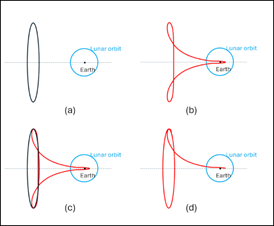
Panels (a) and (b) show two separate periodic orbits in the CR3BP. Being periodic means that despite their closeness, as shown in panel (c), they do not cross in phase space and so a transfer of the restricted body from red to black or vice versa is forbidden. It is possible to ‘force’ the transfer by way of a maneuver somewhere in the vicinity of where the red trajectory, after it ‘loops back’, begins to cross the dotted line (which is the line joining the two massives in the rotating frame and so contains the $x$ axis). However, in the ephemeris model, the elliptic motion of the Earth/Moon about the solar system barycenter allows to a maneuver free transition between red and black. For programmatic reasons that had to do with the hardware JWST flew, the observatory did not take advantage of this dynamical ‘freebie’ but it was there for the taking nonetheless. In my design work to make the JWST transfer work, I used the mirror theorem as a guide but I didn’t use the targeting technique suggested by it. Instead, I used one of my own devising which allowed for incredibly rapid generation of trajectories – a feature that was particularly important given the number of times JWST’s launch date slipped.